


Please Leave Us A Message
Privacy statement: Your privacy is very important to Us. Our company promises not to disclose your personal information to any external company with out your explicit permission.

Blowing agents are specialized chemical compounds used to create controlled cellular structures within rubber products. When activated by heat during the vulcanization process, these agents release gases that form uniform bubbles or pores throughout the material.
For B2B buyers and procurement specialists, understanding blowing agent chemistry is critical because it directly impacts product performance, production efficiency, and final application suitability. The right blowing agent selection can reduce material costs while improving mechanical properties like flexibility, compression set resistance, and thermal stability.
Ningbo Actmix Rubber Chemicals Co., Ltd. specializes in pre-dispersed rubber chemicals and additives, including advanced blowing agent systems designed for high-end rubber applications such as automotive sealing strips, rail traffic components, hoses, shock absorbers, and tires. Our formulations ensure consistent cell structure, reliable expansion rates, and excellent compatibility with EPDM and other rubber compounds.
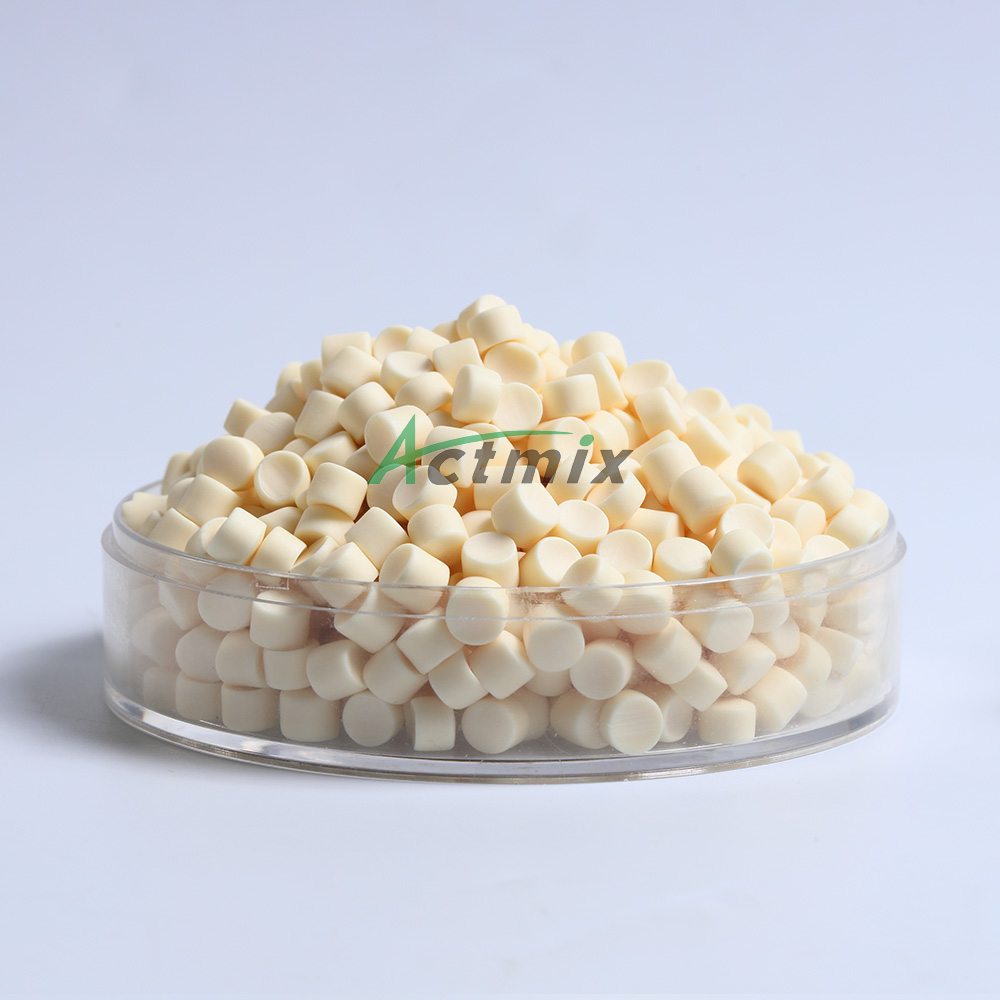
High Stability & Dispersibility: Our pre-dispersed blowing agents feature exceptional homogeneity, ensuring uniform gas release and consistent cell structure across every production batch. This reduces scrap rates and improves yield for your rubber compounding operations.
Custom Formulation Capability: Actmix provides tailored masterbatch solutions with adjustable active content percentages and polymer binders optimized for your specific rubber compound formulation. Whether you need azodicarbonamide-based systems or alternative blowing agents, we engineer solutions that match your processing parameters.
Reduced Procurement Risk: With certifications including ISO 14001 and ISO 45001 alongside IATF 16949, Actmix meets stringent international quality and environmental standards. Sourcing from our facility simplifies supplier qualification audits and ensures regulatory compliance across global markets.

Actmix operates a modern, intelligent, and fully digital factory located in Ningbo Jiangbei High-tech Park. Established in 2009, this state-of-the-art manufacturing facility produces up to 25,000 metric tons annually with precise process control at every stage—from raw material sourcing to final packaging of blowing agent masterbatches.
Every batch of rubber blowing agent undergoes comprehensive testing for particle size distribution, activation temperature range, gas evolution volume, and residual content levels. Our quality management system ensures that each shipment meets or exceeds customer specifications for consistency and performance.
Actmix holds IATF 16949 (automotive industry standard), ISO 14001 (environmental management), and ISO 45001 (occupational health and safety) certifications. These credentials provide B2B buyers with confidence in supply chain reliability, environmental responsibility, and worker safety standards—critical factors for global procurement decisions.
Different blowing agents activate at specific temperature thresholds. Azodicarbonamide (AC) typically decomposes between 180°C–220°C, making it suitable for standard EPDM and NBR processing. For lower-temperature compounds or heat-sensitive substrates, consider modified blowing agents with adjusted activation profiles. Matching agent decomposition temperature to your cure cycle prevents premature gas release or incomplete expansion.
The desired foamed rubber density and cell morphology dictate blowing agent type and dosage. Fine, uniform cells require agents with high nucleation efficiency and rapid gas evolution kinetics. Pre-dispersed blowing agent masterbatches from Actmix offer superior dispersibility compared to free-flowing powders, reducing agglomeration risks and delivering more predictable cell structure in finished rubber parts.
Free powder blowing agents can create dust hazards and uneven dispersion in rubber mixes. Pre-dispersed masterbatch formats eliminate these issues by embedding the active blowing agent within a compatible polymer binder. This format improves worker safety, simplifies dosing procedures, and enhances mixing uniformity—reducing variability in your compounded rubber batches.
The polymer binder in a pre-dispersed blowing agent must be chemically compatible with your base rubber (EPDM, NBR, CR, silicone, etc.). Incompatible binders can cause phase separation, poor adhesion, or defects in the final product. Actmix engineers custom masterbatch formulations with binders selected specifically for your rubber system, ensuring optimal integration during mixing and vulcanization.
Automotive, rail, and construction applications often impose strict regulations on volatile emissions, flame retardancy, and toxicity. Verify that your chosen blowing agent complies with relevant standards such as REACH, RoHS, or OEM-specific material specifications. Actmix provides full technical data sheets and regulatory documentation to support your compliance verification process.
Before committing to large-scale procurement, request sample quantities for trial runs in your actual production equipment. Actmix offers technical consultation and sample programs to help you evaluate blowing agent performance under your specific processing conditions. Our engineering team provides guidance on optimization, troubleshooting, and scale-up support throughout the evaluation process.
Verify IATF 16949, ISO 9001, ISO 14001, and ISO 45001 certifications
Confirm annual production capacity meets your volume requirements
Review export history and references from similar industries
Confirm activation temperature range matches your vulcanization cycle
Verify active content percentage and gas evolution volume specifications
Check particle size distribution for your mixing equipment capabilities
Negotiate pricing based on volume tiers and long-term contract terms
Clarify lead times, minimum order quantities, and delivery schedules
Confirm packaging options, labeling, and documentation requirements
Based in Ningbo Jiangbei High-tech Park and established in 2009, Actmix is a leading Chinese manufacturer of pre-dispersed rubber chemicals and additives, including specialized blowing agent masterbatches. With an annual production capacity of 25,000 metric tons from their intelligent digital factory, Actmix serves the global rubber industry with consistent, high-quality products.
Key Advantages for B2B Buyers:
Why Actmix Stands Out: Unlike suppliers offering only commodity-grade blowing agents, Actmix provides engineered pre-dispersed masterbatch solutions that deliver superior dispersibility, reduced handling hazards, and more consistent foaming results. Their technical support team works collaboratively with procurement and R&D departments to optimize formulations for your specific applications.
EPDM rubber sealing strips for vehicle doors, windows, and trunk lids rely on precise foaming technology to achieve optimal compression recovery, weather resistance, and acoustic insulation. Actmix blowing agent masterbatches enable manufacturers to produce seals with uniform cell structure, ensuring long-term performance against water infiltration, wind noise, and thermal transfer.
Railway vehicles require durable rubber seals, gaskets, and vibration dampening components that meet stringent fire safety and emission standards. Pre-dispersed blowing agents from Actmix support the production of low-smoke, zero-halogen (LSZH) foamed rubber products suitable for train door seals, window glazing, and underframe mounting elements.
Flexible industrial hoses for hydraulic, pneumatic, and fluid transfer applications benefit from foamed rubber intermediate layers that provide cushioning, abrasion resistance, and improved bend radius. Controlled blowing agent activation creates closed-cell structures that maintain pressure integrity while reducing overall component weight.
Rubber-metal composite shock absorbers and engine mounts use foamed rubber inserts to isolate vibrations and absorb impact energy. Consistent cell structure from reliable blowing agent dispersion is essential for maintaining damping characteristics over the product's service life, preventing premature failure due to cell collapse or uneven compression.
While less common than in solid rubber products, certain tire components such as innerliner materials, sound-absorbing foam inserts, and specialty off-road tire treads utilize microcellular foaming techniques. Advanced blowing agent systems enable fine-cell structures that contribute to noise reduction, fuel efficiency, and ride comfort improvements.
Building expansion joints, bridge bearings, and waterproofing membranes incorporate foamed rubber products that accommodate structural movement while maintaining watertight seals. Durable, UV-resistant blowing agent formulations ensure long-term elasticity and compression set performance in exterior exposure conditions.
Free powder blowing agents are unbound chemical particles that must be manually dispersed into rubber compounds during mixing. This approach can lead to uneven distribution, dust generation, and handling hazards. Pre-dispersed blowing agent masterbatches embed the active agent within a compatible polymer binder, creating a free-flowing granular product that disperses more uniformly, reduces dust exposure, simplifies dosing, and delivers more consistent foaming results across production batches.
Blowing agent dosage depends on your target foamed rubber density, the gas evolution volume of the specific agent, and your rubber compound formulation. A typical starting point is 1–5 phr (parts per hundred rubber) for pre-dispersed masterbatches, but optimal dosage requires trial testing. Actmix technical consultants can help calculate initial dosage recommendations based on your desired density and then refine through iterative sample testing on your production equipment.
Yes. Actmix offers full customization services, adjusting both the active blowing agent concentration and the polymer binder type to match your base rubber (EPDM, NBR, CR, silicone, SBR, etc.) and processing conditions. Whether you need high-active-content formulations for low-density foams or specialized binders for particular mixing temperatures, Actmix engineers tailor masterbatch solutions to your exact requirements.
Prioritize suppliers with IATF 16949 (automotive quality), ISO 9001 (general quality management), ISO 14001 (environmental management), and ISO 45001 (occupational health and safety). These certifications demonstrate systematic quality control, environmental responsibility, and worker safety practices. Additionally, verify REACH compliance, RoHS conformity, and any OEM-specific material approvals required for your end-use applications.
With an annual production capacity of 25,000 metric tons and an intelligent digital factory, Actmix maintains robust inventory management and streamlined production scheduling. Standard lead times typically range from 15–30 days depending on order volume and formulation complexity. Rush orders and custom formulations may require additional time. Contact Actmix sales for current availability and delivery estimates for your specific requirements.
Yes. Pre-dispersed masterbatch formats significantly reduce airborne dust compared to free powder agents, lowering inhalation risks and improving workplace air quality. The granular form also minimizes cross-contamination during handling and storage. While all rubber chemicals require appropriate PPE and safe handling procedures, pre-dispersed blowing agents represent a meaningful improvement in occupational safety for your production floor.
About Us
Related Products List
Contact Us

Send Inquiry
Privacy statement: Your privacy is very important to Us. Our company promises not to disclose your personal information to any external company with out your explicit permission.
Fill in more information so that we can get in touch with you faster
Privacy statement: Your privacy is very important to Us. Our company promises not to disclose your personal information to any external company with out your explicit permission.